
Porcelain teapots and jugs: series manufacturing
A teapot is one of the hardest pieces in porcelain: several cast parts, assembled by hand, that must pour without dripping. Here is how it is made.
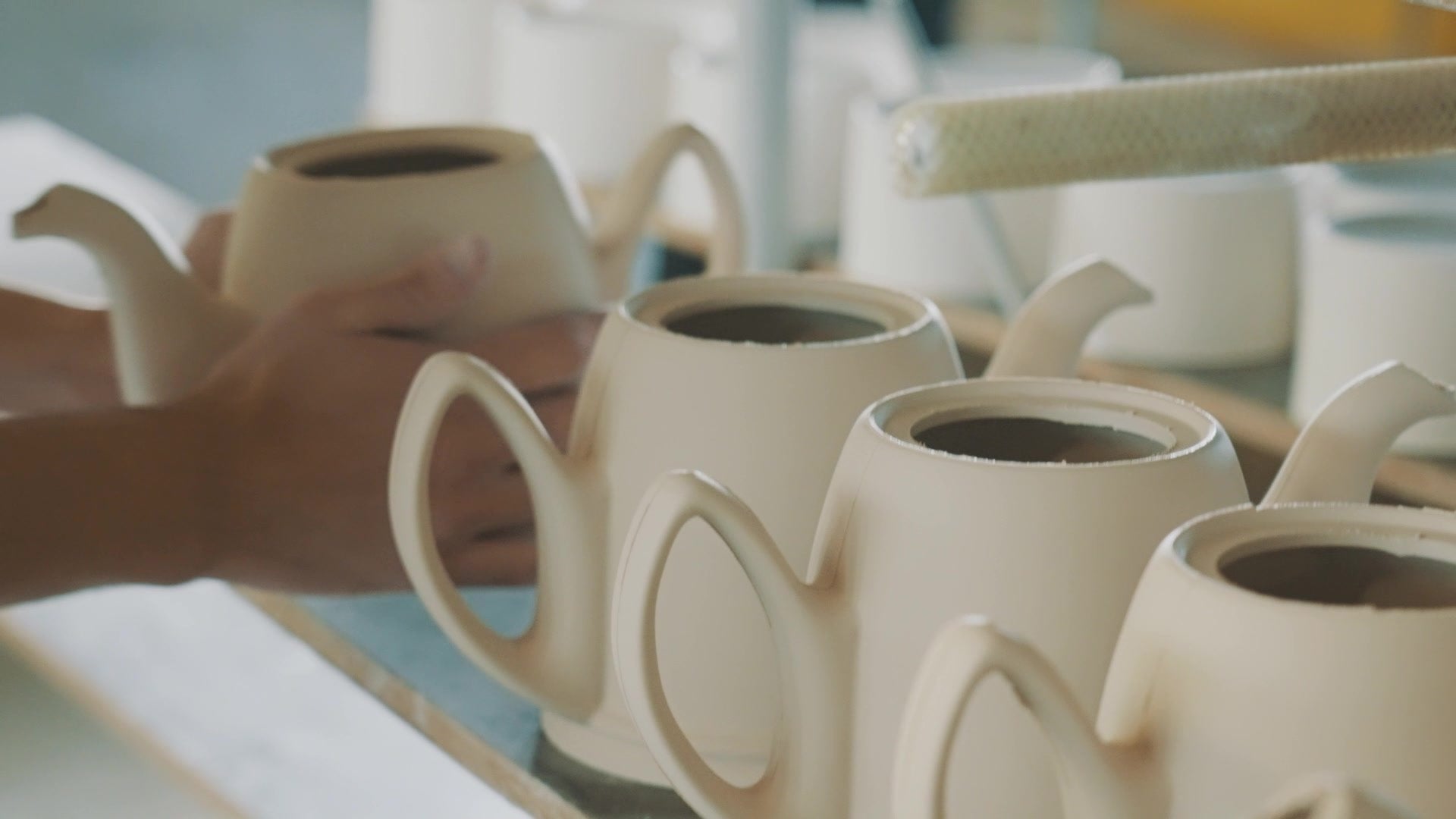
A piece in several parts
Body, spout, handle and lid are cast separately, then joined by hand to the still-unfired piece with slip. The joint must be invisible and strong after firing.
A spout that pours well
A good spout pours in a clean stream and does not drip. Its height, which must rise above the fill level, its angle and the sharpness of its lip are set in the model and checked on the prototypes.
Strainer and lid
A grid pierced in the wall at the base of the spout holds back the leaves. The lid has a lug that stops it falling when pouring, and an air hole that steadies the flow.
The handle
It must stay cool, give a secure grip even when full, and balance the piece. Its shape and position are approved in the hand, on a prototype.
Decoration
Coloured glaze, gold line, decal, coloured body: the teapot carries the service's decoration. A metallic decoration, gold or platinum, is chosen knowing it is not microwave-safe.
A house that knows the craft
Guy Degrenne has been designing teapots for a long time: the Salam teapot, created in 1953, is part of the company's history. Today our Alföld factory produces teapots and jugs in series, for our collections and as private label.
Who it is for
Hotels and tea rooms, tea brands that want their own teapot, décor retailers, and restaurants looking for a jug in their image.
Why does a teapot drip?
Usually because of the shape of the spout and its lip. A well-drawn spout with a sharp edge cuts the flow of tea; it is fine-tuned on a prototype.
Does the lid stay on when pouring?
A deep enough flange or a retaining lug keeps the lid in place when the teapot is tilted.
Information for a quote
Send the drawing or a reference piece, the capacity, the decoration, the volumes and the launch schedule.