
Hollow stainless parts: deep drawing, bar turning or fabrication?
A hollow stainless steel part can be deep drawn, welded, turned from bar, machined or cast. Trade terms get mixed up in enquiries: the right choice depends on shape, volumes, sealing and the finish expected.
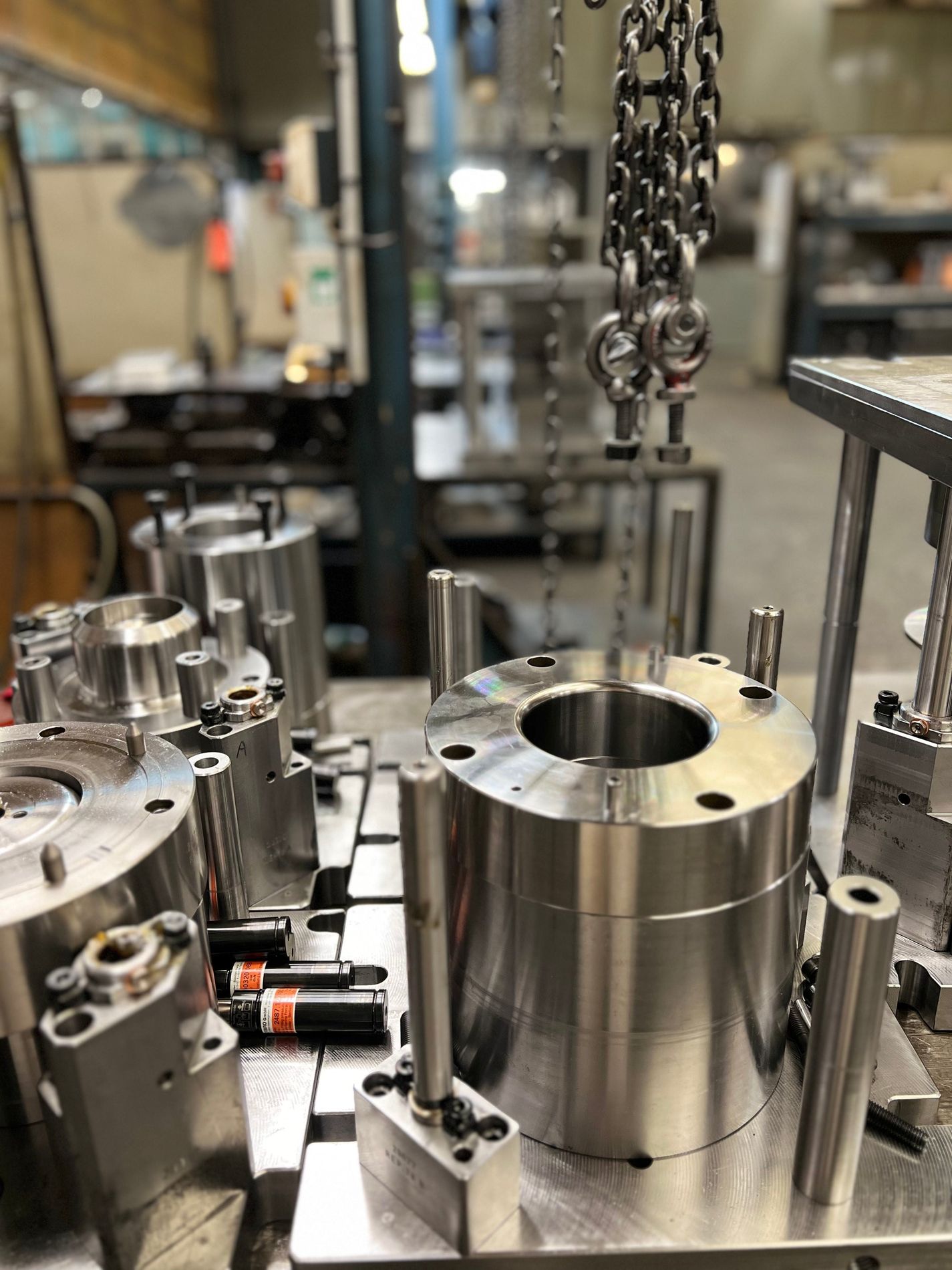
Ways to make a hollow part
A stainless steel bowl, tank, cup or housing can come from a single drawn sheet, from several sheets cut and welded together, from a machined block or from a casting. Each solution has its own cost logic and its limits.
Trade terms are loose: the same part is asked for as turning, as fabrication, as deep drawing. What separates them is not the vocabulary but where the material starts.
Deep drawing
Under a press, a punch draws the blank into a die, while a blank holder controls the draw-in of the metal. Deep parts are formed in several passes, with annealing between two passes if needed.
The part comes out in one piece, without welds, with thin and even walls. Once the tool is made, every press stroke gives a part: the tooling investment is amortised over the volumes, and the unit cost falls with quantity.
Welded assembly
The part is built from sheets that are cut, bent or rolled, then welded. The method needs little dedicated tooling and suits large dimensions and small runs.
On the other hand, every seam must be welded, inspected and reworked during finishing, and watertightness depends on the quality of each weld. Labour time per part quickly weighs on cost as volumes increase.
Machining from solid
The part is cut from a block or bar of stainless steel. No dedicated tooling is needed and precision is excellent, which makes it a good solution for prototypes and thick technical parts.
But most of the material ends up as chips, cycle times are long and thin walls are hard to achieve: the unit cost remains high, even in series.
Bar turning
Bar turning, or screw machining, removes material: a metal bar or wire rotates on an automatic lathe while cutting tools shape it. It produces small, solid parts of revolution, accurate to a hundredth of a millimetre: screws, shafts, fittings, threaded ends, bushings.
On a hollow part the arithmetic turns against it. To obtain an 80 mm cup you start from an 80 mm bar and hollow it out: most of the metal leaves as swarf. A drawn blank ends up almost entirely in the finished part, with a thin, even wall that never had to be cut away.
The rule of thumb: bar turning for a small, solid, very precise part; deep drawing for a hollow part with thin walls. Many enquiries arrive asking for turning when the drawing calls for deep drawing, and the other way round.
Plate fabrication
Plate fabrication forms thicker sheet by rolling, folding and welding, for tanks, hoppers, covers and large structures. It follows the same logic as welded assembly on another scale: no dedicated tooling, so nothing to amortise, which makes it unbeatable for one-offs and very short runs.
Its limit is the same too: labour time per part does not fall with quantity. As soon as the run grows and the part fits under a press, deep drawing takes the lead again, with a seamless part and no weld to inspect.
Casting
Casting allows massive and very complex shapes. Walls, however, are thicker than with drawing, the part often needs machining afterwards, and the surface is less easily mirror polished.
How to choose
Ask yourself four questions. What annual volumes? The higher they are, the more competitive drawing becomes. Must the part be watertight? A one-piece drawn part naturally is. What wall thickness? Drawing excels with thin, even walls. What finish? A part drawn from austenitic stainless steel is particularly well suited to mirror polishing.
The engineering office compares the solutions on your drawing: tooling cost, part cost, lead times and feasibility.
Which process for small quantities?
For small quantities, laser cutting or metal spinning avoid costly tooling. Deep drawing makes sense when volumes pay for the tool.
Can several processes be combined?
Yes: a part can be laser cut, deep drawn, welded and then polished. At Vire, these steps take place on the same site.
Do you offer bar turning?
No. At Vire we deep draw, laser cut, weld, heat treat and finish stainless steel. If your drawing calls for bar turning we will say so at the study stage rather than waste your time. If the part is hollow and thin-walled, it is exactly what we do.
Our approach in Vire
Deep drawing is our historic expertise. Before any tooling, we simulate drawing pass by pass, then validate the shape with a 3D-printed steel prototype. Complementary operations, 3D laser cutting, laser or TIG welding of sub-assemblies, satin finishing and polishing, are carried out on the same site.