
Laser cutting stainless steel: flat, 3D and 5-axis
Once a part is deep drawn, it often has to be trimmed or opened up. A 3D laser does it without a dedicated tool, following the shape of the part.
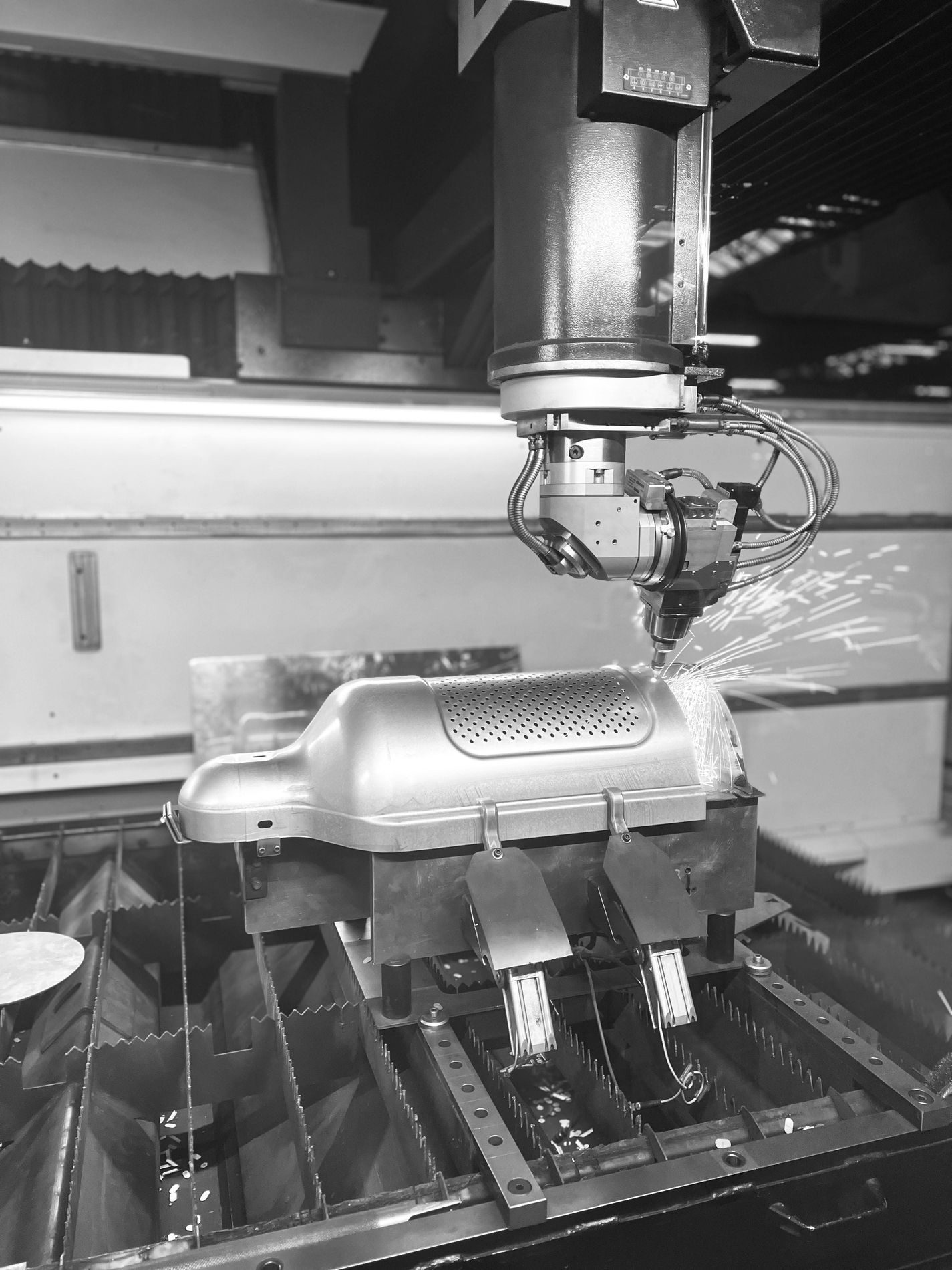
The principle
A focused laser beam melts the metal along a very fine line, and a gas blows the molten material away. In 3D cutting, the laser head is carried by a multi-axis system: it tilts to stay perpendicular to the surface and follows the curves of the part.
2D and 3D: two uses
2D laser cutting works on flat sheet: it cuts blanks or flat parts. 3D cutting comes after forming, on a drawn, rolled or welded part, to trim it, pierce it or cut openings that cannot be made flat.
We do both. Our 5-axis machine orients the cutting head in every direction: it cuts flat sheet as readily as an already formed part, staying perpendicular to the surface whatever the curvature. That is what lets us take a part from blank to final trimming without changing machine.
What a 5-axis machine changes
On a conventional cutter the head stays vertical: the part must be flat, and a sloped edge comes out bevelled. With five axes the head tilts and swivels. It follows the real profile of the part and always meets the material square.
In practice that gives three things: clean openings on curved walls, trimming that follows the true height of the part, and cutting angles impossible to reach otherwise. No dedicated tool is needed: only the program changes from one reference to the next.
Why cut after drawing
A hole cut before drawing distorts during forming. Cutting afterwards guarantees the exact position and shape of the openings, even on a curved wall.
For trimming, the laser follows the actual height of the part and leaves a clean edge, ready for curling, welding or polishing.
Laser or punching?
Press punching is unbeatable in speed on very large runs, but it needs a dedicated tool for each shape, which is costly to modify. The laser only needs a program: it suits prototypes, changing parts, complex shapes and medium runs.
On the same part, the two are often combined: punching for simple, repetitive holes, laser for shapes and hard-to-reach areas.
Cut quality
The laser leaves a clean edge with few burrs and a very narrow heat-affected zone, which limits distortion. On stainless steel, nitrogen cutting keeps a clean, bright edge without oxidation, which can stay visible or be finished.
From prototype to series
The cutting program is prepared from the 3D file of the part. The same equipment is used for the first parts and for production, which speeds up development and lets a design change without remaking a tool.
One step in a complete chain
In Vire, laser cutting follows on from deep drawing, welding, heat treatment, polishing and silver plating, in the same factory. Parts do not leave the site between operations.
Does laser cutting leave burrs?
A well-tuned cut leaves a clean edge. Deburring or polishing may follow depending on how the part is used.
What is the difference between laser cutting and laser engraving?
Cutting goes through the sheet to create an outline; engraving only marks the surface, for a logo, text or number.
Information for a quote
Send the drawing or 3D file of the part, the grade and thickness, the annual volumes and your appearance requirements for the cut edges.