
Welding stainless steel: TIG, laser and weld finishing
A handle, a foot, a bracket: some parts cannot come from a single blank. Welding joins them, provided the heat and the look of the weld are under control.
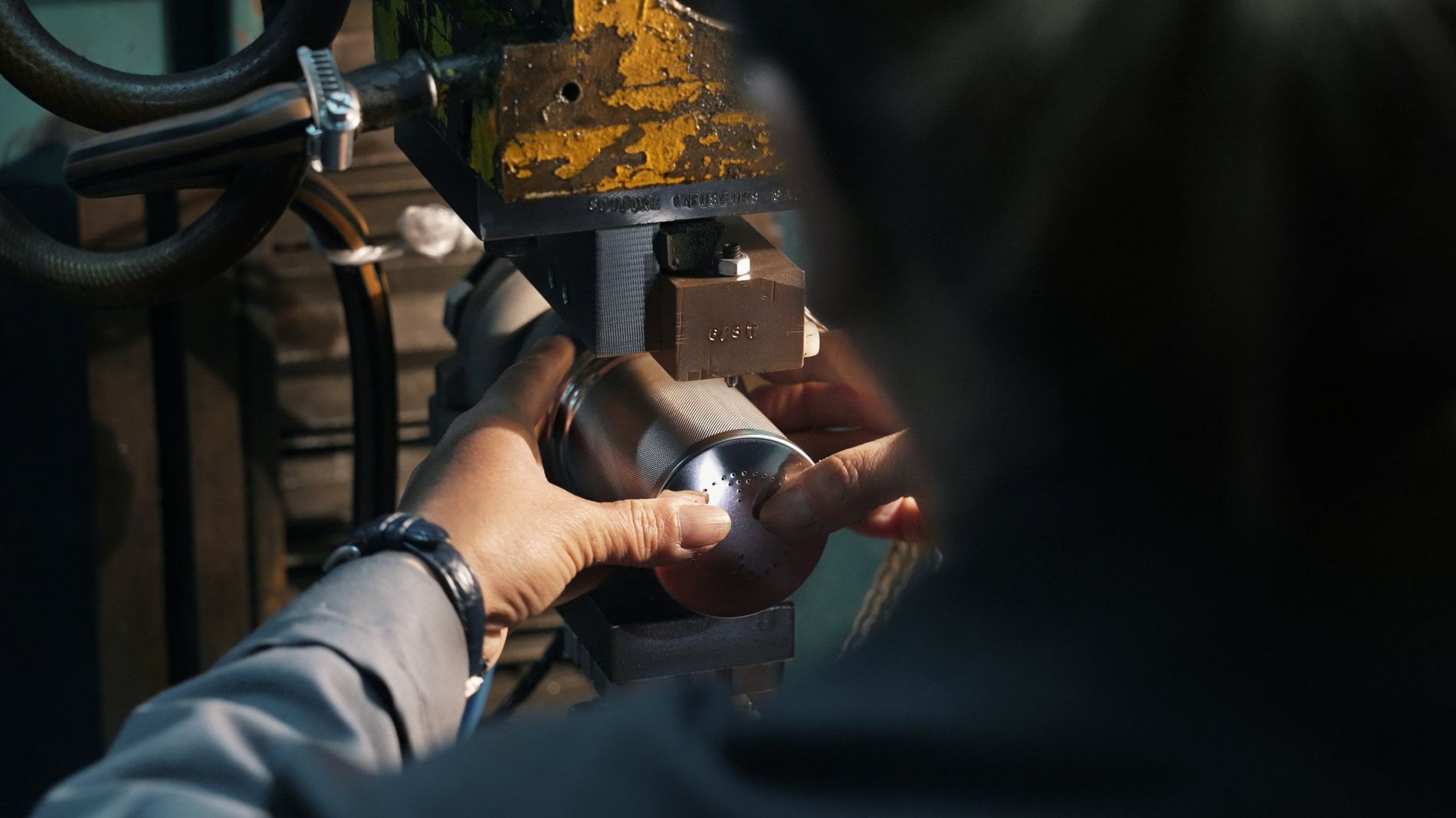
When to weld
We weld what cannot be formed in one piece: a handle, a foot, an added bottom, a bracket, a fitting. When the shape allows, a one-piece deep-drawn part remains stronger and easier to clean, but many objects combine both.
Welding is planned from the design stage: its position, access and final appearance depend on it.
TIG: precise and versatile
TIG welding strikes an electric arc between a tungsten electrode, which does not melt, and the part. An inert gas, usually argon, shields the weld pool from the air. Filler metal may or may not be added.
The weld is clean and precise. TIG suits thin gauges and visible parts, manual or automated.
Laser: fine, fast, little distortion
Laser welding concentrates very high energy on a tiny spot. The weld is narrow and deep, the heated zone small, distortion minimal and speed high.
It is ideal for repetitive assemblies in high volume and for thin parts, provided the edges are prepared precisely: the gap between parts must be very small.
Controlling the heat
Stainless steel conducts heat poorly and expands a lot: heated locally, it distorts. Clamping, the welding sequence and the right energy keep this under control.
Around the weld, heated stainless steel discolours: these oxides reduce its corrosion resistance. The back of the weld is shielded with gas, then the area is pickled, passivated or polished to restore all of the steel's properties.
The grade matters
304, or 18/10, welds very well and keeps its corrosion resistance. 430, or 18/0, is weldable but needs more care, as the welded zone can become more brittle.
The choice of grade therefore takes the planned welds into account, not just the drawing.
An invisible weld
On a visible part, the weld is ground flush and polished with the rest of the part. On a mirror finish, the slightest irregularity shows: weld quality and position are decided upstream, with our design office.
One step in the chain
In Vire, welding follows on from deep drawing, laser cutting, heat treatment and polishing, in the same factory. Parts move from one operation to the next without leaving the site, and each step is inspected.
Is a weld visible on a polished part?
It is blended in during polishing. Deep drawing the part in one piece often avoids the need to weld.
Does a weld resist corrosion?
Yes, if it is well made then pickled and passivated: the stainless steel regains its protective layer.
Information for a quote
Send the drawing or 3D file, the grade and thickness, the annual volumes, any leak-tightness or strength requirements, and the visible areas where the weld must disappear.