
Press tooling: single-operation, progressive and transfer dies
Before the first part, there is the tool. Its design determines the quality, speed and cost of the whole run: here is how a die is chosen, made and maintained.
What the tool does
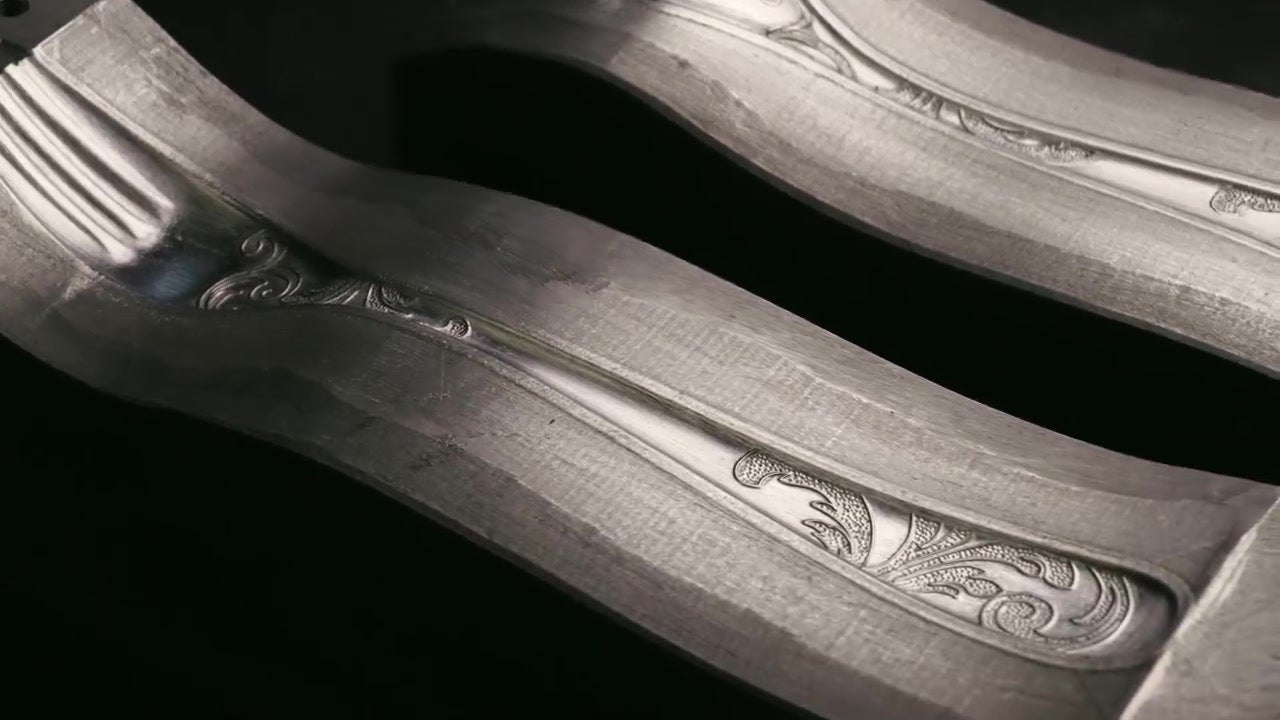
A press tool is an assembly of hardened steel parts, mounted on the press, that cuts, forms or punches the metal at each stroke. It always has two halves: the punch, which pushes the metal, and the die, whose shape the part takes. In deep drawing, a blank holder clamps the edge of the blank and controls how the metal flows.
The geometry of the tool sets the shape, radii, surface finish and accuracy of the part. That is why tooling is designed together with the part, not afterwards.
Single-operation dies: one operation per tool
A single-operation die performs one operation only: blanking, drawing, trimming or piercing. The part moves from one tool to the next, from one press to another, by hand or by robot.
It is the most flexible and least expensive solution to build. It suits large parts, deep shapes that need several draws and annealing, and medium runs.
Progressive dies: the whole sequence in one tool
A progressive die links several operations in a single tool. The metal strip advances one step at each press stroke; at each station the tool cuts, pierces or forms a little more, and the finished part drops off at the last station.
It costs more to design and set up, but it produces at very high speed with excellent repeatability. It is the choice for small and medium parts made in large volumes.
Transfer dies: for larger parts
In a transfer die, the part is separated from the strip at the start, then moved from station to station by a transfer system. It keeps the automatic sequence of a progressive die for parts that are too large or too deep to stay attached to a strip.
It is a frequent choice for medium-sized hollow parts produced in series.
How to choose
The choice depends on four criteria: the size and depth of the part, its thickness, the annual volume and the stability of the design. A part likely to change is best started on single-operation dies; a frozen part produced in large numbers quickly pays for a progressive die.
Our design office compares the options with you from the quotation stage, weighing the cost of tooling against the cost of the part over the life of the product.
From simulation to try-out
The tool is drawn in CAD from the part. Forming simulation anticipates wrinkles, thinning and springback, which reduces the number of trials.
Once the tool is built comes the try-out on the press: radii, clearances and blank holder pressure are adjusted until the part is compliant, then the first parts are approved before the run is launched.
Tooling made in-house
In Vire, the toolroom is part of the factory: we design, build, set up and maintain our tools on site. A modification or a repair is done without waiting for an outside supplier, and production restarts faster.
With 53 presses up to 1,000 tonnes, every tool finds the machine suited to its size and the force it needs.
Tool life, maintenance and archives
A well-designed, well-maintained tool produces for years. It wears, is reground and refurbished, and its wear parts are replaced. Tool monitoring is part of our quality system.
In Vire, the tools of past collections have been kept for years, even decades: for significant volumes, a part can be put back into production without remaking the tooling.
Does a deep drawing tool wear?
Yes, it is maintained: polishing, replacing wear parts, adjustments. A well-maintained tool produces long series.
Can an old tool be reused?
Tools from past collections are kept at Vire. For significant volumes, they can be brought back into service after inspection.
Who owns the tool?
In subcontracting, the tooling dedicated to a part is often invoiced separately to the customer, who becomes its owner, while the manufacturer stores and maintains it. Ownership, storage and maintenance terms are set out in the quotation: it is a point to clarify from the start.