
Stainless steel bowls and vessels for appliances: series manufacturing
A kitchen appliance bowl must be safe in contact with food, geometrically precise and identical from one part to the next, over very large runs. Here is how it is made.
What an appliance bowl must do
A food processor bowl or a cooker vessel heats up, spins, is washed every day and touches food. It must resist corrosion, clean easily, fit the appliance exactly and stay perfectly consistent from one part to the next.
These requirements drive everything: the grade, the process and the inspection.
Deep drawing, in one piece
The safest shape for a bowl is a one-piece deep-drawn part: no weld in the bottom, no corner where food can cling. The blank is formed in several draws on high-tonnage presses, with annealing where needed to restore the metal's ductility.
In Vire, high-volume deep drawing of bowls and vessels is one of our core skills, on 53 presses up to 1,000 tonnes.
Choosing the grade
304, or 18/10, is the reference grade: very ductile for deep drawing, it resists corrosion well and takes a fine polish. 430, or 18/0, has no nickel and is magnetic: it is used in particular when the part must heat by induction.
The choice takes into account the heating method, the cleaning products and the desired look.
Operations after forming
Once the shape is obtained, the part is trimmed and then given its functions: holes and openings cut by laser, edge curling, welding of added parts, heat treatment.
Each operation is designed to preserve the geometry and the inner surface of the bowl.
Inner and outer finish
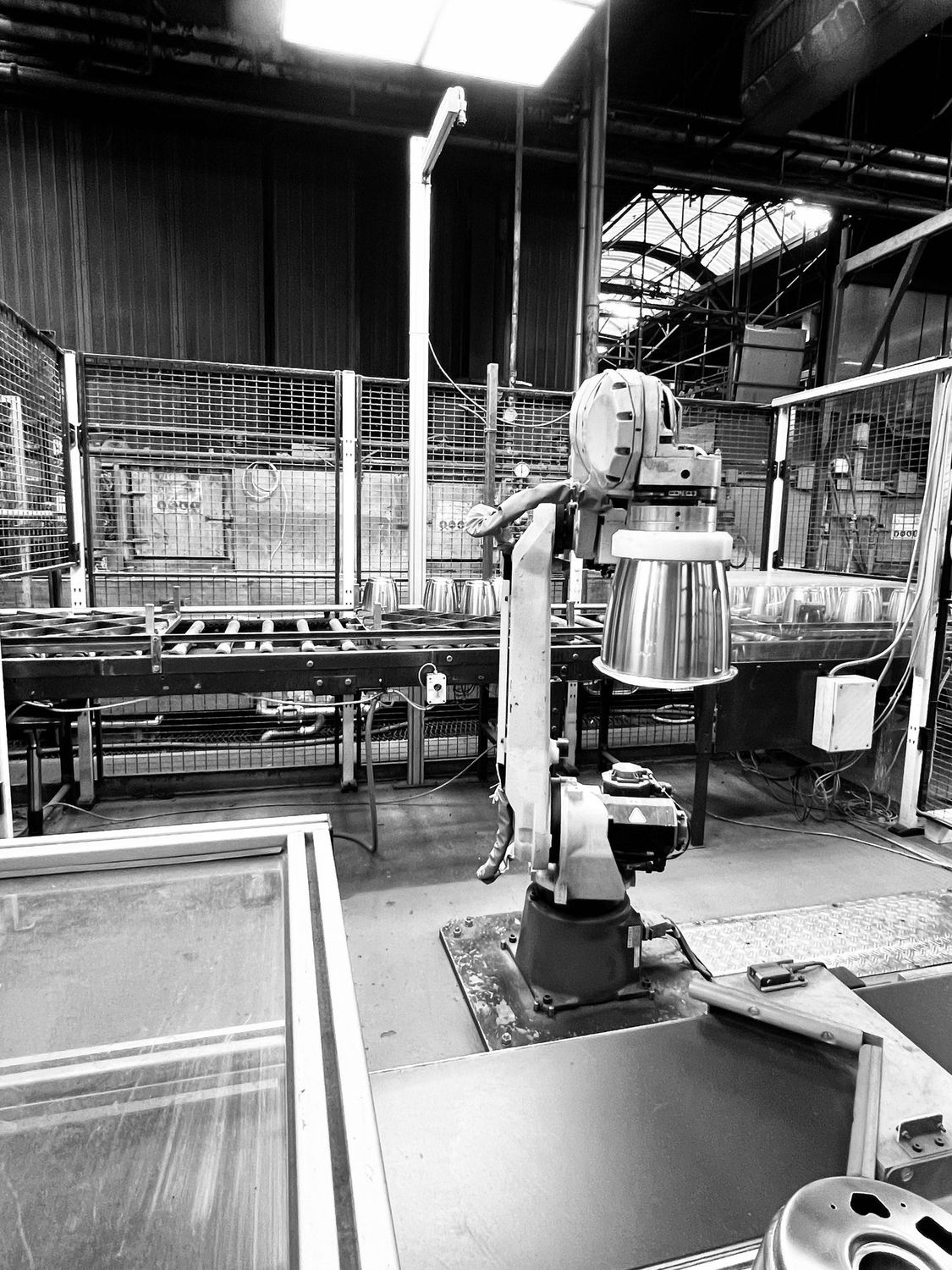
The inside of a bowl must be smooth and easy to clean; the outside, often visible, carries the signature of the appliance. Automatic polishing, on robots and dedicated machines, guarantees a consistent finish across the whole run, mirror-polished or satin.
Inspection in series
Dimensions, appearance, functions: the inspection plan is defined with the customer and applied to every lot. Traceability of the material, from steel heat to finished part, is part of our ISO 9001:2015 certified quality system.
Food contact
The bowl touches food: the stainless steel grade must comply with food-contact rules, and manufacturing must leave no residue. Our dedicated guide explains the regulations for stainless steel and the documents to ask for.
Can graduations be added?
Yes, embossed during drawing or laser engraved. Their position and legibility are approved with the appliance's use and cleaning.
Can the base be induction compatible?
It depends on the grade and the base design. This is set in the specification, with the appliance maker.
Information for a quote
Drawings or 3D file, grade and thickness, annual volumes and delivery rhythm, inner and outer finishes, inspection requirements. Our design office works with you from the design stage to make the part simple to manufacture.