
Heat treatment of stainless steel: annealing explained
As it deforms, stainless steel hardens. To go further in shape without cracking it, it is heated: annealing, a discreet but decisive step in deep drawing.
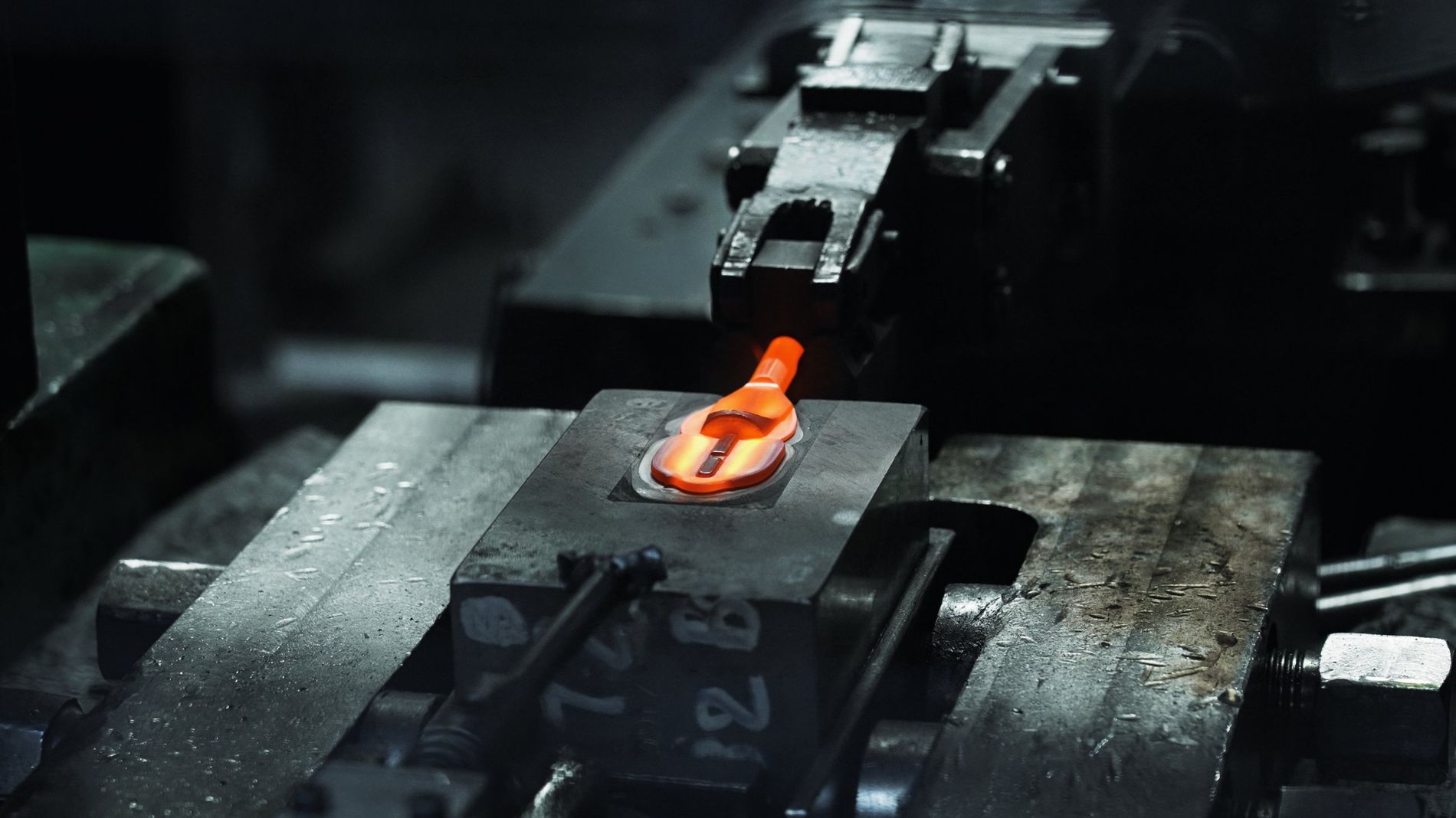
Work hardening: metal hardens as it deforms
With each draw under the press, the metal deforms and its structure tightens: it becomes harder and less malleable. This is work hardening. Beyond a certain point, further deformation would crack it.
Austenitic stainless steel, such as 304, work-hardens strongly: this makes it strong, but also limits how deep a single draw can go.
Annealing restores ductility
Annealing means heating the part to a high temperature, then cooling it. Its structure re-forms, its stresses disappear and the metal becomes malleable again.
For austenitic stainless steel, the part is generally heated to around 1,050 °C, followed by rapid cooling that preserves its corrosion resistance.
Between draws
A very deep part is formed in several draws, with annealing between them when the metal requires it. The number of draws and anneals depends on depth, thickness and grade.
Forming simulation helps keep it to the strict minimum, which shortens the process and lowers the cost of the part.
Final annealing
After heavy deformation or welding, a final treatment can remove internal stresses, stabilise dimensions and restore full corrosion resistance. It is decided according to the grade, the part and its use.
Protecting the surface
At high temperature in air, stainless steel forms an oxide layer that must then be removed by pickling or polishing. Annealing under a protective atmosphere, known as bright annealing, avoids this oxidation and keeps the surface clean.
304 and 430: two behaviours
304, or 18/10, is very ductile and accepts the deepest draws, with intermediate annealing. 430, or 18/0, work-hardens less but cannot be drawn as far: it suits shallower shapes.
Heat treatment is adapted to each.
The furnace at the heart of the factory
In Vire, heat treatment is part of the factory, between the presses: parts go from furnace to press without leaving the site, avoiding transport and waiting between draws.
Does annealing change the look of stainless steel?
It can dull the surface; a protective atmosphere or later polishing preserves it.
Are all parts annealed?
No: only when deformation requires it, between passes or at the end of forming.
Information for a quote
Send the drawing or 3D file, the grade and thickness, the annual volumes and any specific requirements for hardness, corrosion resistance or appearance. Our design office defines the full process, annealing included.